

Semaglutide vs tirzepatide for weight loss is a medical decision, not only a contest over which injection produces a larger change on the scale. Both medicines influence appetite and glucose regulation, but they work through different receptor pathways.
A suitable choice depends on obesity-related conditions, medical history, treatment goals, side-effect tolerance, and the ability to continue long-term monitoring.
Wegovy contains semaglutide, while Zepbound contains tirzepatide. This article focuses on physician-supervised treatment for adults with obesity or overweight. Clinical trial averages are useful for comparison, but they cannot predict an individual’s result.
Semaglutide vs Tirzepatide for Weight Loss – Main Differences
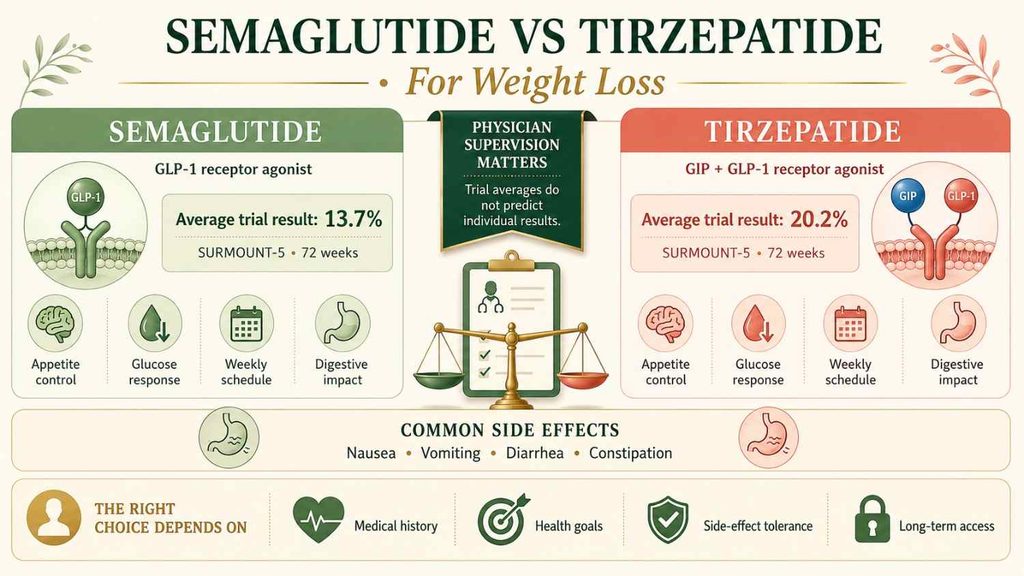
The current Wegovy label describes semaglutide as a selective GLP-1 receptor agonist. The Zepbound label describes tirzepatide as a dual GIP and GLP-1 receptor agonist.
| Feature | Semaglutide | Tirzepatide |
| Weight-management brand | Wegovy | Zepbound |
| Receptor activity | GLP-1 | GIP and GLP-1 |
| Starting injection dose | 0.25 mg weekly | 2.5 mg weekly |
| Usual maintenance | 1.7 or 2.4 mg weekly | 5, 10, or 15 mg weekly |
| Current maximum injection dose | 7.2 mg for eligible adults | 15 mg weekly |
| Additional clinical consideration | Established cardiovascular disease and certain cases of noncirrhotic MASH | Moderate-to-severe obstructive sleep apnea with obesity |
How the Two Medicines Work
Semaglutide imitates GLP-1 activity. It increases glucose-dependent insulin secretion, reduces inappropriate glucagon release when glucose is elevated, and acts on brain pathways controlling hunger and fullness.
It also slows gastric emptying. These effects can lower appetite, cravings, portion size, and overall calorie intake.
Tirzepatide activates both GLP-1 and glucose-dependent insulinotropic polypeptide receptors. Its combined activity influences appetite, insulin secretion, insulin sensitivity, gastric motility, and glucose control.
Response to either medicine can be affected by
- Diabetes and baseline insulin resistance
- Dose tolerance and treatment duration
- Sleep, eating patterns, and other medications
- Physical activity and treatment adherence
- Individual biological response
Expected Weight-Loss Results
The clearest direct evidence comes from the 72-week SURMOUNT-5 trial. It included 751 adults with obesity, or overweight with a related condition, who did not have diabetes. Participants received the maximum tolerated dose of tirzepatide, 10 or 15 mg, or semaglutide, 1.7 or 2.4 mg.
Average body-weight reduction was 20.2% with tirzepatide and 13.7% with semaglutide. Average waist reduction was 18.4 cm and 13.0 cm, respectively.
Tirzepatide produced greater mean weight reduction at the tested doses, but this does not mean it will outperform semaglutide in every patient.
Separate trials offer further context:
- STEP 1 reported an average 14.9% reduction with semaglutide 2.4 mg at 68 weeks.
- SURMOUNT-1 reported average reductions of 15.0%, 19.5%, and 20.9% with tirzepatide 5, 10, and 15 mg at 72 weeks.
- STEP UP reported an 18.7% reduction with semaglutide 7.2 mg under its treatment-policy analysis, compared with 15.6% for 2.4 mg.
STEP UP did not compare semaglutide 7.2 mg directly with tirzepatide. Results from different trials should not be ranked as if their populations, dosing, adherence, and statistical methods were identical.
Weight reduction also tends to vary with diabetes status, baseline weight, dose reached, and time on treatment. No percentage should be promised before treatment.
Who May Qualify for Treatment?
Prescription obesity medicine is considered for an adult with a BMI of at least 30 kg/m², or a BMI of at least 27 kg/m² with a weight-related condition.
Examples include hypertension, dyslipidemia, type 2 diabetes, cardiovascular disease, or obstructive sleep apnea. Both medicines are used with appropriate nutrition and physical activity.
BMI alone does not establish candidacy. A physician may also assess
- Weight history, waist circumference, and previous treatment
- Blood pressure, glucose status, lipids, and current medications
- Kidney, liver, pancreatic, gallbladder, and gastrointestinal health
- Retinopathy, sleep apnea, eating behavior, and reproductive plans
Both products are contraindicated in patients with a personal or family history of medullary thyroid carcinoma or Multiple Endocrine Neoplasia syndrome type 2.
Previous serious hypersensitivity to the medicine is another contraindication. Common hypothyroidism and Hashimoto’s disease are not the same as these conditions, though the full thyroid history still needs to be reviewed.
Severe gastroparesis, previous pancreatitis, gallbladder disease, recurrent dehydration, kidney disease, diabetic retinopathy, and insulin or sulfonylurea use require added attention.
Patients must also tell an anesthesia or endoscopy team that they use an incretin medicine because delayed gastric emptying may affect procedural planning.
Pregnancy and Contraception
Weight-loss treatment is not recommended during pregnancy. Semaglutide should generally be stopped at least two months before a planned pregnancy because it remains in the body for an extended period. Tirzepatide should be stopped when pregnancy is recognized.
Tirzepatide may reduce oral hormonal contraceptive effectiveness during treatment initiation and dose escalation. The FDA label advises switching to a non-oral method or adding barrier protection for four weeks after starting tirzepatide and for four weeks after each dose increase.
Side Effects and Warning Signs of Semaglutide vs tirzepatide for weight loss
The most common adverse effects are gastrointestinal, particularly while the dose is increasing:
- Nausea, vomiting, diarrhea, or constipation
- Abdominal discomfort, reflux, bloating, or burping
- Reduced appetite and fatigue
- Injection-site reactions
Persistent symptoms may require slower escalation, dose reduction, or a different treatment. Repeated vomiting and dehydration should never be accepted as proof that the medicine is working.
Less common but serious concerns include pancreatitis, gallbladder disease, kidney injury caused by fluid loss, severe gastrointestinal reactions, and serious allergies.
Hypoglycemia becomes more likely when either medicine is combined with insulin or sulfonylurea. Rapid glucose improvement may temporarily worsen diabetic retinopathy in susceptible patients.
Seek prompt medical advice for severe or persistent abdominal pain, repeated vomiting, very low urine output, jaundice, facial swelling, breathing difficulty, or new vision changes.
Dose Progression and Monitoring
Semaglutide injection usually begins at 0.25 mg weekly. It normally increases every four weeks through 0.5 mg, 1 mg, and 1.7 mg. Standard maintenance is 1.7 or 2.4 mg.
Current labeling permits 7.2 mg for selected adults who have tolerated 2.4 mg for at least four weeks and still need further weight reduction.
Tirzepatide begins at 2.5 mg weekly for four weeks, then increases to 5 mg. Later increases occur in 2.5 mg steps after at least four weeks at the current dose. Maintenance options are 5, 10, or 15 mg. The 2.5 mg amount is an initiation dose, not a maintenance dose.
There is no milligram-for-milligram conversion. The medicines should not overlap, and switching must be supervised. During treatment, monitoring may include
- Weight, waist, blood pressure, appetite, and adverse effects
- Glucose and hypoglycemia risk in patients with diabetes
- Kidney function when vomiting or diarrhea causes fluid loss
- Vision, pancreatic, gallbladder, and gastrointestinal symptoms
- Nutrition, strength, and physical function
A SURMOUNT-1 body-composition analysis found that about 75% of weight lost with tirzepatide was fat mass and 25% was lean mass. Appropriate resistance exercise and individualized nutrition may help protect muscle during treatment.
Why a Physician May Prefer One Medication – Semaglutide vs tirzepatide for weight loss
Tirzepatide may be considered when greater average weight reduction is an important clinical target, and the patient has no contraindication. It is also indicated for moderate-to-severe obstructive sleep apnea in adults with obesity. In the SURMOUNT-OSA trials, it improved apnea severity, weight, and hypoxic burden.
Semaglutide may receive preference when cardiovascular evidence is especially relevant. In SELECT, semaglutide 2.4 mg reduced major cardiovascular events by 20% among adults with established cardiovascular disease and overweight or obesity but without diabetes.
Current Wegovy labeling also covers certain adults with noncirrhotic metabolic dysfunction-associated steatohepatitis and moderate-to-advanced fibrosis, supported by the phase 3 ESSENCE trial.
The final choice may also depend on previous response, adverse effects, pregnancy plans, retinopathy, gastrointestinal health, route preference, availability, insurance coverage, and long-term cost. Greater mean weight reduction does not make medicine suitable for everyone.
Long-Term Treatment and Reinvi MD Support
Obesity pharmacotherapy is long-term. Weight regain was common after treatment withdrawal in the STEP 1 semaglutide extension and the SURMOUNT-4 tirzepatide trial. Regain reflects chronic disease biology, not weak willpower. Patients should not stop and later restart at an old high dose without guidance.
ReinviMD uses a physician-led evaluation that may include weight and medication history, metabolic risk, relevant laboratory testing, contraindication screening, and treatment goals.
Follow-up can address dose response, gastrointestinal symptoms, hydration, glucose, nutrition, and muscle protection. Treatment may be slowed, changed, or stopped when medically appropriate.
Conclusion – Selecting the Right One – Semaglutide vs tirzepatide for weight loss
Choosing semaglutide vs tirzepatide for weight loss requires more than comparing average trial results. Tirzepatide produced greater mean weight reduction at the doses studied in SURMOUNT-5, while semaglutide has strong cardiovascular evidence and additional clinical uses.
Safety history, treatment tolerance, related health conditions, access, and long-term monitoring may change the decision.
Neither medication guarantees a particular result. Reinvi MD can assess candidacy, select a medically suitable option, guide gradual dose progression, and monitor safety and response. This information is educational and does not replace personal medical care.
Elevate Your Wellness: Transformative Health Journeys at Reinvi MD, Houston’s Premier Medical Wellness and Aesthetic Spa
Transform your health and elevate your wellness with Reinvi MD, the premier destination for medical wellness and aesthetics in Houston, Texas. Scheduling an appointment is seamless and convenient through our website, and while same-day appointments may not always be available, we strive to accommodate your schedule within the week.
Financial concerns should never hinder your wellness journey. At Reinvi MD, we offer flexible in-house payment plans and collaborate with Cherry and Patient Fi to provide zero-percent interest financing options. Unlike traditional insurance plans that can restrict your choices, we empower you to make healthy decisions tailored to your unique needs and priorities.
Our services go beyond conventional treatments, offering advanced weight management programs, rejuvenating skin facials and restoration, incontinence treatments, hormone replacement therapy, body sculpting, and contouring.
With compelling patient testimonials and impressive before-and-after results, Reinvi MD is dedicated to delivering comprehensive care that transforms lives. Experience exceptional care and board-certified expertise at Reinvi MD and set a new standard for your health and wellness today.
📍 Reinvi MD – Skin, Body & Wellness Clinic
✅ Skin Rejuvenation • Body Contouring • Physician-Led Aesthetic Care
📌 Address: 17110 House Hahl Rd Ste B-2A, Cypress, TX 77433
📞 Phone: (281) 475-4512
📷 Instagram: instagram.com/reinvimd
Stay inspired with client transformations, behind-the-scenes treatments, and expert skin tips.
📘 Facebook: facebook.com/reinvimd
Join our community, see reviews, get exclusive offers, and book directly through our page.
References
https://pubmed.ncbi.nlm.nih.gov/38078870
https://pubmed.ncbi.nlm.nih.gov/35441470
https://pubmed.ncbi.nlm.nih.gov/40305708
https://pubmed.ncbi.nlm.nih.gov/37952131
https://pubmed.ncbi.nlm.nih.gov/38912654
https://pubmed.ncbi.nlm.nih.gov/39996356
https://pubmed.ncbi.nlm.nih.gov/40961952
https://pubmed.ncbi.nlm.nih.gov/35658024
https://pubmed.ncbi.nlm.nih.gov/33567185
https://pubmed.ncbi.nlm.nih.gov/40353578
https://www.accessdata.fda.gov/drugsatfda_docs/label/2026/215256s025lbl.pdf