
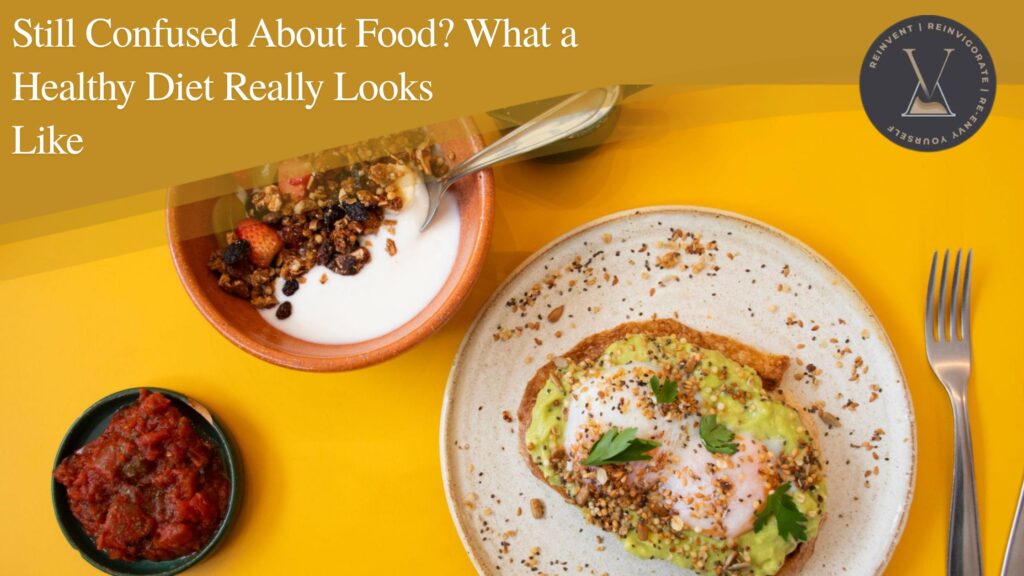
What does a healthy diet look like, most people still feel confused about it, and honestly, not without reason. Everywhere you look, there’s a new rule, a new restriction, something to cut out. One day carbs are bad, next day fats are the problem.
This constant noise makes healthy eating feel complicated, almost frustrating. But the truth is, what does a healthy diet look like isn’t defined by trends or extremes. It’s defined by how your body actually functions, not what social media says.
At a physiological level, the body runs on energy balance. Total Daily Energy Expenditure (TDEE) sets the baseline, and your intake either supports or disrupts that balance. But calories alone don’t tell the full story.
What does a healthy diet look like also depends on nutrient density, foods that provide vitamins, minerals, and fiber instead of empty calories that do little beyond energy. This difference, small but important, affects metabolism more than people realize.
Then there’s the hormonal side. GLP-1, insulin, and leptin constantly regulate hunger, fullness, and energy use. When eating lacks structure, these signals become inconsistent, and things start to feel off.
That’s where a physician-guided approach like Reinvi MD makes a difference. Instead of crash dieting, the focus stays on sustainable metabolic alignment, where the body adapts gradually and results actually hold.
What Does a Healthy Diet Look Like in a Metabolic Framework?
When you look at it from a metabolic side, what does a healthy diet look like, it’s not random meals or guessing portions. It follows a system where nutrients actively support energy regulation, hormonal balance, and cellular function.
The body doesn’t just need food, it needs the right kind of input. And when that input aligns properly, metabolism responds better almost smoothly.
What Does a Healthy Diet Look Like in Terms of Nutrient Composition?
At the nutrient level, what does a healthy diet look like, it comes down to balance, not extremes or elimination.
- Protein supports lean mass preservation and improves satiety signaling, helping control hunger naturally
- Carbohydrates provide energy, but when sourced from fiber-rich foods, they also support glycemic control and digestion
- Fats regulate endocrine function and support cellular health, especially when coming from unsaturated sources
This mix matters. Removing one group completely? usually creates imbalance, and the body notices it quickly.
Beyond macros, micronutrient density plays a big role, sometimes overlooked.
- Vitamins and minerals support metabolic pathways
- Antioxidants help reduce oxidative stress
- Whole, minimally processed foods deliver more usable nutrients
At the same time, certain foods disrupt this balance more than people expect.
- Ultra-processed foods often lack real nutritional value
- High sugar intake spikes glucose, then drops energy
- Excess sodium affects fluid balance and cardiovascular stress
So really, what does a healthy diet look like, it’s not about perfection. It’s about giving your body consistent, nutrient-dense input so systems can function without constant correction.
What Does a Healthy Diet Look Like in Real-Life Application?
In real life, what does a healthy diet look like, it’s simple, but not careless. You don’t overcomplicate meals, you just structure them better. The goal is consistency, not perfection. When your daily eating follows a pattern your body understands, things start to feel more stable energy, hunger, even mood.
Sustainable Weight and Health Outcomes
Practically, what does a healthy diet look like, it often follows a plate model that’s easy to repeat.
- 50% vegetables and fruits → fiber, vitamins, and micronutrients that support overall health
- 25% protein → helps with satiety, muscle maintenance, and metabolic function
- 25% whole grains → provides steady energy and supports digestion
But food alone isn’t everything, behavior matters too, sometimes even more.
- Meal timing supports better satiety regulation and prevents overeating
- Hydration (around 6–8 glasses daily) helps maintain metabolic processes
- NEAT, your daily movement, keeps energy expenditure active beyond workouts
In a clinical setting like Reinvi MD, this structure becomes more personalized.
- Nutrition plans adjust based on individual metabolic response
- GLP-1 support helps regulate appetite more naturally
- Hormonal optimization improves how the body uses energy
So really, what does a healthy diet look like, it’s not just food. It’s how food, behavior, and metabolism all come together.
Curious about non-surgical weight loss options that actually work? Explore your best-fit treatments and book a consult now.

Conclusion – What Does a Healthy Diet Look Like
And finally, what does a healthy diet have to be like, it is not about rules and eliminating everything you like. It’s structure. A program that your body can stick to without being stressed or lost. The best diet is one that remains nutrient-dense and is sustainable, not one that is extreme and difficult to follow.
And frankly speaking, as soon as that framework is established, things begin to become a little less difficult, a little more natural. It should never be about restriction but rather about balance. You do not have to give up whole categories of foods in order to achieve results, you simply need to change your eating habits.
It is best to be consistent than perfect, though not every day will be just as intended. What is a healthy diet in real life, it is something you can do every day, not something you find hard to do a week and give up. What is more important is that its purpose should change.
The long-term metabolic health is more important than the short-term dieting outcomes. The fixes that are made in a flash could display changes, but they seldom last.
An organized, balanced method promotes energy, hormones, and general functioning in the course of time. This is more specific with a physician-based model such as Reinvi MD.
It shifts towards metabolic-based weight management; nutrition is done in accordance with the needs of your body. This will eventually help to lose fat sustainably and optimize health in the long run, which is actually what the majority of people are after.
Elevate Your Wellness: Transformative Health Journeys at Reinvi MD, Houston’s Premier Medical Wellness and Aesthetic Spa
Transform your health and elevate your wellness with Reinvi MD, the premier destination for medical wellness and aesthetics in Houston, Texas. Scheduling an appointment is seamless and convenient through our website, and while same-day appointments may not always be available, we strive to accommodate your schedule within the week.
Financial concerns should never hinder your wellness journey. At Reinvi MD, we offer flexible in-house payment plans and collaborate with Cherry and Patient Fi to provide zero-percent interest financing options. Unlike traditional insurance plans that can restrict your choices, we empower you to make healthy decisions tailored to your unique needs and priorities.
Our services go beyond conventional treatments, offering advanced weight management programs, rejuvenating skin facials and restoration, incontinence treatments, hormone replacement therapy, body sculpting, and contouring.
With compelling patient testimonials and impressive before-and-after results, Reinvi MD is dedicated to delivering comprehensive care that transforms lives. Experience exceptional care and board-certified expertise at Reinvi MD and set a new standard for your health and wellness today.
📍 Reinvi MD – Skin, Body & Wellness Clinic
✅ Skin Rejuvenation • Body Contouring • Physician-Led Aesthetic Care
📌 Address: 17110 House Hahl Rd Ste B-2A, Cypress, TX 77433
📞 Phone: (281) 475-4512
📷 Instagram: instagram.com/reinvimd
Stay inspired with client transformations, behind-the-scenes treatments, and expert skin tips.
📘 Facebook: facebook.com/reinvimd
Join our community, see reviews, get exclusive offers, and book directly through our page.